Program Director's Notes - Our Visit to Auschwitz

Hi everyone,
Last Wednesday, our family visited Auschwitz, which we reached by taking a train from Krakow to Oświęcim, a small village 70 km to the west. The camp’s location isn’t obvious, but you know you’ve arrived when you see the buses and tourists streaming behind the gates.
The camp is divided into several sites. At Auschwitz I, we saw striped prisoners’ uniforms, tattooing instruments, mounds of eyeglasses and kitchenware, bags of women’s hair, and photographs of families carrying suitcases, standing beside boxcars. At Birkenau, we saw where new arrivals were sorted into two groups: those sent into slave labor and those sent to extermination. We visited the claustrophobic bunkers for those “sent to the right,” and we viewed the gravel remains of undressing rooms, gas chambers, and ovens for those “sent to the left.” On all sides, we were surrounded by watchtowers and barbed wire.
Like many descendants of European Jews, my connection to the Holocaust is personal. In France, we had relatives who disappeared. In Kovne (Kaunas), Lithuania, we had family who were cast into the Baltic Sea on a boat that was set ablaze. We know the story because one cousin escaped the flames and made it to Australia and later told my mother and grandparents.
The Holocaust also feels personal because of the role physicians played. The notorious Dr. Josef Mengele performed medical experiments on prisoners at Auschwitz and chose who would live and who would die. Hundreds and perhaps thousands of physicians contributed to the genocide—some enthusiastically, some because they lacked the will to resist.
In the Holocaust, we recognize that even the most cultured and scientifically advanced societies can descend into depravity. Even sophisticated professionals like physicians can become instruments of cruelty, untethered to morality.
As we go about our days, may we honor the inherent worth of all humans, may we use our medical expertise solely for the good, and may we find the courage to be voices of conscience, even in trying times.
Have a restful Sunday, everyone. I’ll be walking over to the Jewish Museum of Berlin, and tomorrow we’ll be flying to Bulgaria,
Mark
P.S. Please consider attending this year’s Lindenthal Lecture on Holocaust and Genocide on April 22, “Nazi Doctors: Learning from Complicity”
P.P.S. Recommended reading and viewing:
Books
Night by Elie Wiesel
Man’s Search for Meaning by Victor Frankl
Survival in Auschwitz by Primo Levi
Auschwitz: A Doctor’s Eyewitness Account by Miklos Nyiszli
Black Earth by Timothy Snyder
Eichmann in Jerusalem by Hannah Arendt
Films
Schindler’s List
The Reader
The Pianist
Sophie’s Choice
The Zone of Interest’
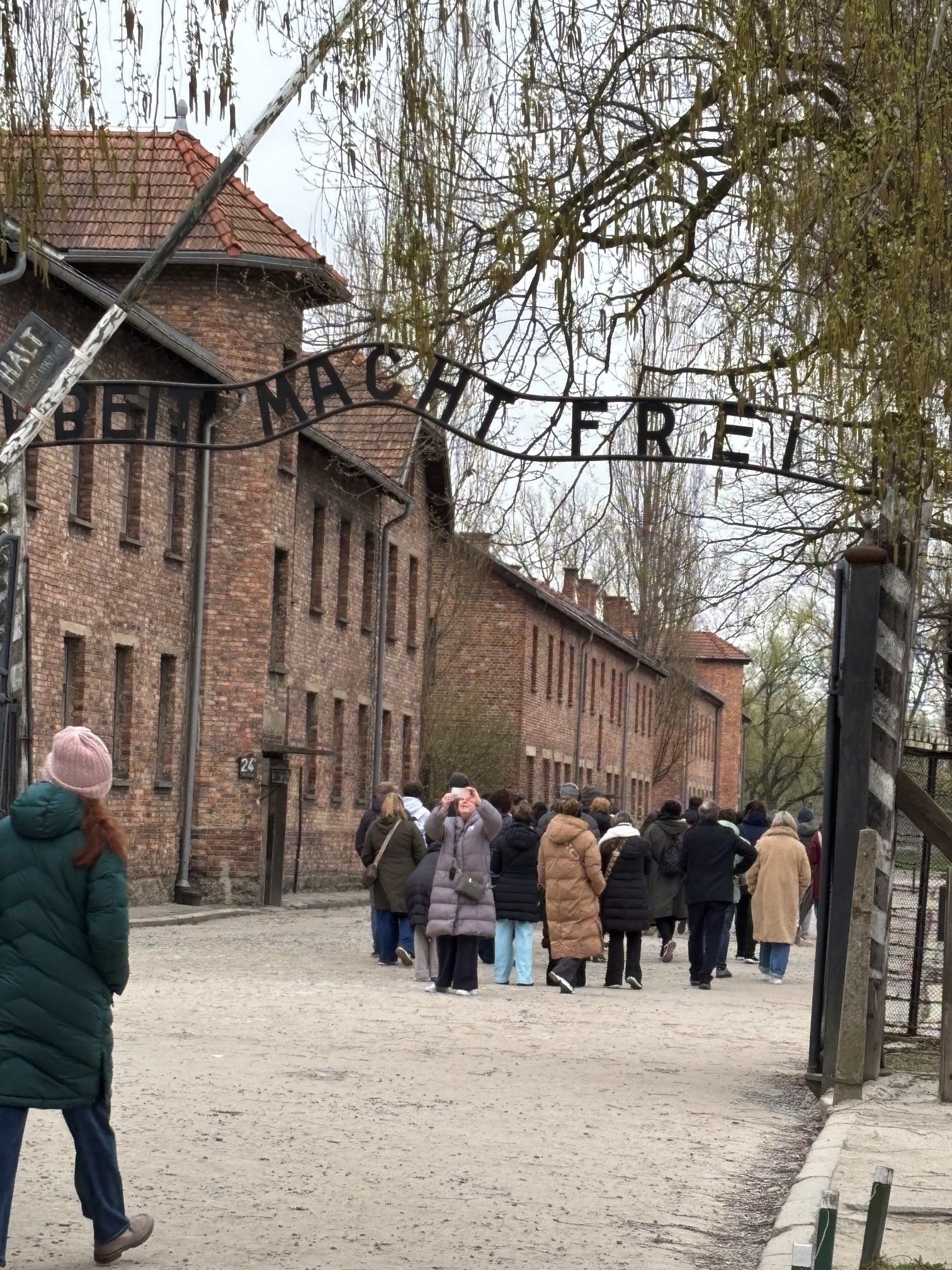
Enterng Auschwitz, April 8, 2026